In short
Form 122A-1 works out “current monthly income,” which has a specific legal meaning: the average of what came in during the six full calendar months before filing. It then multiplies by 12 and compares the result with the median income for a household of the same size in the same state.
At or below the median, the means test ends here and there’s no presumption of abuse. Above it, the longer calculation on Form 122A-2 is required.
Who files it
Individuals filing under Chapter 7. Someone who is exempt from the means test, because their debts aren’t primarily consumer debts or because of qualifying military service, files Form 122A-1Supp along with it.
What it asks
Part 1: Calculate Your Current Monthly Income
Marital and filing status, then six-month averages for each kind of income: wages, support, contributions from others to household expenses, business and rental income, interest and dividends, unemployment, pensions and anything else. A spouse’s income has its own column when it counts.
Part 2: Determine Whether the Means Test Applies to You
The yearly figure, the median family income for your state and household size, and which is larger.
Part 3: Sign Below
A signature under penalty of perjury.
When it’s filed
It’s filed with the petition, or within 14 days after it. That’s the deadline Bankruptcy Rule 1007(c) sets for the schedules and statements.
Related forms
- Chapter 7 Means Test Calculation (Official Form 122A-2)
- Statement of Exemption from Presumption of Abuse Under §707(b)(2) (Official Form 122A-1Supp)
- Schedule I: Your Income (Official Form 106I)
The official form
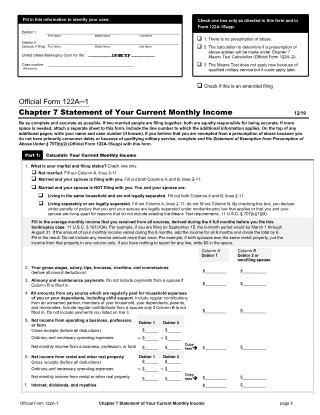
Official Form 122A-1 is 3 pages long and is used in Chapter 7 only cases. This guide describes the 12/19 revision, the date printed beside the form’s title. The federal courts publish the form and replace it when it changes, so their page always has the current one.
BK Prepare’s questionnaire builds the list of forms for a case from your answers, and includes this one when it applies.