In short
Schedule I is a snapshot of monthly income on the day of filing. That makes it different from the means test forms, which average the six months before.
It counts a spouse’s income in more cases than people expect. The form asks about a spouse who lives with you whether or not they’re filing. A separated spouse who isn’t filing is left off.
Who files it
Every individual debtor, in Chapter 7 and Chapter 13.
What it asks
Part 1: Describe Employment
Employment status, occupation, employer and how long you’ve worked there, for you and for Debtor 2 or a non-filing spouse.
Part 2: Give Details About Monthly Income
Gross wages, then each payroll deduction (taxes, retirement contributions, insurance, support, union dues), then every other source: business or rental income, interest and dividends, family support, unemployment, Social Security, other government assistance, pensions. It ends with combined monthly income and a question about any increase or decrease expected in the year after filing.
When it’s filed
It’s filed with the petition, or within 14 days after it. That’s the deadline Bankruptcy Rule 1007(c) sets for the schedules and statements.
Related forms
- Schedule J: Your Expenses (Official Form 106J)
- Chapter 7 Statement of Your Current Monthly Income (Official Form 122A-1)
- Chapter 13 Statement of Your Current Monthly Income and Calculation of Commitment Period (Official Form 122C-1)
- Summary of Your Assets and Liabilities and Certain Statistical Information (Official Form 106Sum)
The official form
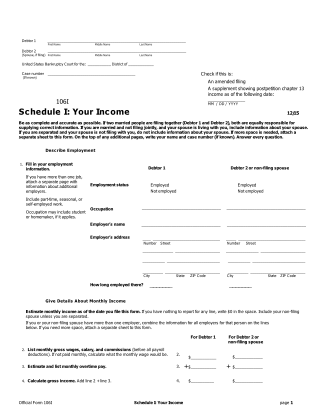
Official Form 106I is 2 pages long and is used in Chapter 7 and Chapter 13 cases. This guide describes the 12/15 revision, the date printed beside the form’s title. The federal courts publish the form and replace it when it changes, so their page always has the current one.
BK Prepare’s questionnaire builds the list of forms for a case from your answers, and includes this one when it applies.