The one-sentence version
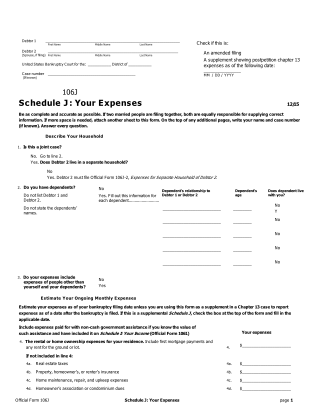
Schedule J lists your actual monthly household expenses as they exist right now - the lived-in budget, not aspirational, not stripped-down.
Schedule J vs. the Means Test deductions - again, not the same
Form 122A-2 (the Means Test) uses standardized allowances published by the IRS - fixed dollar amounts for food, housing, transportation by household size and county. Schedule J uses your actual expenses, whatever they happen to be.
Why the difference matters: a filer who lives well below the IRS standards (frugal, debt-free spouse paying most bills) will show lots of "disposable income" on Schedule I minus J even after passing the Means Test. That can prompt a U.S. Trustee inquiry into whether the case is actually an abuse of Chapter 7 under section 707(b)(3).
What's on the form
Two short setup questions, then a long expense list.
Setup
- Is the property listed at the top of Schedule J also the property you live in? (If you moved between filing and now, explain.)
- Do you have dependents? How many, ages, and relationship?
Expenses - the line items
The form walks every household expense category:
- Rent or home ownership expenses (mortgage payment, property taxes if not escrowed, home insurance, homeowner's-association fees)
- Real estate taxes (if separate)
- Property, homeowner's, or renter's insurance (if separate)
- Home maintenance, repair, and upkeep
- Utilities: electricity, heating fuel, water/sewer/trash, telephone/cell/internet/cable
- Food and housekeeping supplies
- Childcare and children's education costs
- Clothing, laundry, dry cleaning
- Personal care products and services
- Medical and dental expenses (out-of-pocket)
- Transportation (gas, maintenance, parking, public transit, not the car payment)
- Entertainment, clubs, recreation, newspapers, magazines, books
- Charitable contributions and religious donations
- Insurance (not deducted from pay): life, health, disability, vehicle, other
- Taxes (not deducted from pay or in mortgage payment)
- Installment or lease payments: car, other (this is where the actual car loan payment goes)
- Alimony, maintenance, support paid to others
- Other payments you support that don't live with you
- Other real property expenses
- Other expenses not listed (explain - this is where unusual budget items go: medical equipment maintenance, special-needs costs, etc.)
The bottom line
Schedule J totals to a single monthly expense figure. The form then explicitly does the subtraction:
Monthly net income from Schedule I, minus monthly expenses from Schedule J, equals monthly net income (positive or negative).
Good to know: A negative result (more expenses than income) is normal and expected for a Chapter 7 filer - it's mathematical evidence you can't pay creditors. A meaningfully positive result invites the U.S. Trustee to ask why you're filing Chapter 7 instead of Chapter 13.
"Actual" doesn't mean "padded"
List real expenses you actually pay. Trustees pull bank statements and credit-card statements; if you claim $1,200/month in groceries for a one-person household, you'll be asked to explain. Conversely, list real expenses you legitimately incur even if they seem high - documented medical costs, childcare for a special-needs child, large insurance premiums.
Things to remember to include
- Quarterly or annual expenses divided by 12 (car registration, professional licenses, term life insurance)
- Anticipated medical costs you can document
- Costs of a vehicle you actually need to get to work, even if older
- Cell phone, internet, modest streaming services - these are normal household expenses, not luxuries
Things people commonly forget
- Pet expenses (food, vet)
- School-related expenses for kids (lunches, activities, fees)
- Personal hygiene products and haircuts
- Renter's insurance
- Annual costs broken into monthly equivalents
Watch out: Schedule J is the place trustees most often push back on. Round-number entries ($500 for groceries, $200 for utilities, $300 for entertainment) look manufactured. Use your actual bank statements and credit-card statements to pull real averages. If a category fluctuates a lot, average the last 6 months.
Common mistakes
- Using IRS standard amounts instead of actual. Standards belong on Form 122A-2, not here.
- Forgetting the car payment (it goes in "installment payments," not in transportation).
- Double-counting mortgage insurance or property tax that's already escrowed inside the mortgage payment.
- Omitting recurring annual expenses (vehicle registration, certain insurance).
- Listing pre-bankruptcy debt payments in Schedule J. Credit-card minimums, medical-debt payments, personal-loan payments - none of those go here, because they're being discharged.
Related forms
Schedule J works in pair with Schedule I. Both feed Form 106Sum. The Means Test version of expenses is on Form 122A-2. See the complete forms index.