In short
The schedules describe today. The Statement of Financial Affairs, often shortened to SOFA, describes how you got here. It asks where your income came from, who you paid, what you gave away or sold, and what you lost, over set periods before the filing date.
Each question has its own look-back period, from 90 days to 10 years. The trustee uses the answers to check for payments and transfers the Bankruptcy Code lets a trustee undo.
Who files it
Every individual debtor, in Chapter 7 and Chapter 13.
What it asks
Part 1: Give Details About Your Marital Status and Where You Lived Before
Marital status, every address in the last 3 years, and any time in the last 8 years living with a spouse in a community property state.
Part 2: Explain the Sources of Your Income
Income from work or a business, and all other income, for the current year so far and the two calendar years before it.
Part 3: List Certain Payments You Made Before You Filed for Bankruptcy
Payments to a single creditor in the 90 days before filing that add up to $600 or more for someone with mainly consumer debts, or $8,575 or more otherwise (the figure on the 04/25 form). Also payments to relatives and other insiders in the year before filing.
Part 4: Identify Legal Actions, Repossessions, and Foreclosures
Lawsuits and court actions, repossessions, foreclosures, garnishments and levies in the year before filing, and setoffs by a bank or other creditor in the 90 days before.
Part 5: List Certain Gifts and Contributions
Gifts worth more than $600 per person, and charitable contributions totaling more than $600 to any one charity, in the 2 years before filing.
Part 6: List Certain Losses
Losses from theft, fire, other disasters or gambling in the year before filing.
Part 7: List Certain Payments or Transfers
Anything paid in the last year to someone consulted about bankruptcy or debt relief, property sold or transferred in the last 2 years outside the ordinary course, and transfers to a self-settled trust in the last 10 years.
Part 8: List Certain Financial Accounts, Instruments, Safe Deposit Boxes, and Storage Units
Accounts closed, sold or moved in the last year, and safe deposit boxes and storage units held in the last year.
Part 9: Identify Property You Hold or Control for Someone Else
Property that belongs to another person but is in your hands.
Part 10: Give Details About Environmental Information
Notices, releases of hazardous material, and proceedings under environmental law.
Part 11: Give Details About Your Business or Connections to Any Business
Any business you owned or were connected to in the last 4 years, and financial statements given to anyone about a business in the last 2 years.
Part 12: Sign Below
A signature under penalty of perjury.
When it’s filed
It’s filed with the petition, or within 14 days after it. That’s the deadline Bankruptcy Rule 1007(c) sets for the schedules and statements.
Related forms
- Schedule I: Your Income (Official Form 106I)
- Schedule A/B: Property (Official Form 106A/B)
- Declaration About an Individual Debtor’s Schedules (Official Form 106Dec)
- Voluntary Petition for Individuals Filing for Bankruptcy (Official Form 101)
The official form
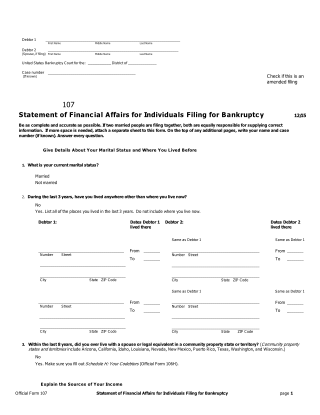
Official Form 107 is 12 pages long and is used in Chapter 7 and Chapter 13 cases. This guide describes the 04/25 revision, the date printed beside the form’s title. The federal courts publish the form and replace it when it changes, so their page always has the current one.
BK Prepare’s questionnaire builds the list of forms for a case from your answers, and includes this one when it applies.