The one-sentence version
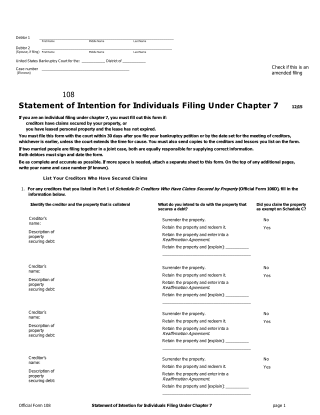
Form 108 is your binding declaration of what you plan to do about each piece of property that secures a debt - and you have to file it within 30 days of filing the petition (or by the 341 meeting, whichever is earlier).
What's on the form
Two parts.
Part 1 - For each secured creditor on Schedule D
You pick one of three options and check the corresponding box:
- Surrender - give the collateral back. The lender takes the property, any deficiency balance becomes an unsecured debt subject to discharge. The most common choice for underwater cars and homes the filer doesn't want.
- Redeem - pay the lender a lump sum equal to the current value of the collateral, get the lien removed, and keep the property free and clear. Only available for personal-use tangible property (typically vehicles, household goods, not real estate). Requires the cash up front - so it's rare for filers who couldn't pay their bills.
- Reaffirm - sign a new contract with the creditor agreeing to keep paying the original debt after the bankruptcy. The debt is excluded from your discharge. Used to keep a car you can afford the payments on.
If the property is your home (a real estate mortgage), there's a separate option: continue paying under the existing contract terms without reaffirming. Some districts handle this as a "ride-through" - you keep paying, the lien stays, the lender doesn't pursue you personally because there's no default - but the local practice varies.
Part 2 - For each lease on Schedule G
For each unexpired lease, you check one box:
- Assume the lease (continue under it) - and the lessor must agree in writing within 30 days under 11 U.S.C. Section 365(p) for personal-property leases.
- Reject the lease - it ends, you return the property, any rejection damages become unsecured.
The 30-day rule
Form 108 must be filed within 30 days of the petition date or by the date set for the 341 meeting, whichever is earlier. Then, within 30 days after the 341 meeting, you have to actually perform your stated intention - sign the reaffirmation papers, pay the redemption amount, or surrender the property.
Miss those deadlines and the automatic stay lifts as to the collateral, which means the creditor can resume repossession or foreclosure activity immediately.
Reaffirmation - the most consequential choice
Reaffirming a debt is a serious move:
- You're agreeing the debt survives your bankruptcy.
- If you can't pay later, the creditor can sue you for the deficiency after repossession - exactly what bankruptcy is supposed to prevent.
- The court has to approve the reaffirmation if you don't have an attorney representing you - they'll hold a hearing to make sure it's voluntary and in your best interest.
- You can rescind a reaffirmation within 60 days of filing it (or before discharge, whichever is later).
The most common reason to reaffirm is to keep a car. The most common reason not to is when the loan is significantly underwater - paying full balance on a car worth less than the loan isn't a great trade.
Good to know: Some courts and lenders allow a "pay and drive" or "retain and pay" approach for vehicles - you keep paying the original loan, the lender doesn't repossess as long as you stay current, and you never sign a reaffirmation. Whether this works depends on your district and your lender. It's the safest middle ground when available.
Redemption math
If your car is worth $6,000 and your loan balance is $12,000, redemption lets you pay $6,000 in cash to keep the car free and clear of the lien. The remaining $6,000 becomes unsecured and is discharged. The catch is having $6,000 in cash on hand. A few specialized lenders (722Redemption Funding being the best known) finance Chapter 7 redemptions at high interest rates - but it can still beat paying $12,000 on a $6,000 car.
Watch out: "Surrender" doesn't mean "drop the car off and walk away" - it means make it available for the lender to take. If they don't pick it up promptly, keep it insured and don't drive it. You can't surrender a car and then keep using it for months without consequences.
Common mistakes
- Picking "reaffirm" because the lender said you have to. Lenders push reaffirmation; you don't always have to sign.
- Missing the 30-day-after-341 deadline to actually do what you said you'd do.
- Forgetting Part 2 leases. Every lease on Schedule G needs a corresponding intention here.
- Not getting lessor consent to assume a personal-property lease (cell phone, car lease) within 30 days.
- Reaffirming an underwater debt without understanding you're undoing the discharge for that specific debt.
Related forms
Form 108 is paired with Schedule D (the secured creditors) and Schedule G (the leases). Reaffirmation agreements themselves are a separate official form (Form 2400A/B/C). See the complete forms index.